
Some family law practices use fee arrangements where a lawyer’s payment depends on achieving a specific outcome in a child support dispute. Under these arrangements an attorney may agree that a client will not pay the usual hourly rates unless a defined success event occurs, such as entry of a child support order, recovery of arrears, or a negotiated enforcement outcome. The agreement typically sets out how success is measured, what portion of any recovered amounts—or what uplift to fees—will be payable, and how out-of-pocket disbursements will be handled. Terms and availability can vary by jurisdiction and by the lawyer’s practice model.
The details of these contingency-style or conditional agreements often differ in scope and timing. For example, some contracts link fees to recovered arrears, others to the obtaining of a formal court order, and some combine a modest retainer or reduced hourly rate with a success fee. Lawyers may exclude certain procedural steps or enforcement costs from the contingency, and clients may remain responsible for third‑party charges such as expert reports or filing fees. Courts and professional regulators in many places may review or limit the form of these agreements in family law matters.

Fee calculation and billing under outcome-dependent arrangements require clear drafting. Agreements commonly specify whether the fee applies to gross recoveries or net amounts after costs, whether interim or partial successes trigger payment, and how disbursements are advanced and repaid. Professional rules in many jurisdictions require that clients receive a written agreement that explains fee calculations, billing intervals, and the client’s exposure to other costs. Because family law proceedings can involve multiple steps—paternity establishment, hearings, enforcement motions—clients and lawyers often negotiate which stages are covered by the conditional element.
Eligibility and case selection commonly influence whether an attorney will offer an outcome-linked arrangement. Matters where there is a clear source of recoverable funds or enforceable arrears tend to attract consideration, while highly contested jurisdictional or custody disputes may be less suited. Lawyers often assess factors such as the likelihood of establishing parental liability, the respondent’s capacity to pay, and the projected cost of litigation before offering a conditional arrangement. Clients may be advised that suitability can depend on evidentiary strength and on whether collection mechanisms are available.
There are practical limits and risks to acknowledge. A success definition that relies on collection rather than just entry of an order may delay fee payment or make recovery uncertain; partial recoveries may prompt disputes over proportional fees. Some agreements allocate responsibility for adverse costs or for disbursements incurred even if the outcome is not favorable. Ethical rules in certain places may place additional restrictions on contingency arrangements in family law, and courts may have authority to review or adjust fee terms in light of fairness concerns.
Clients benefit from clear, written terms covering scope, definitions of success, fee formulas, handling of disbursements, and termination rights. Independent advice or a cooling-off period may be advisable in jurisdictions where professional conduct rules encourage transparency. The next sections examine practical components and considerations in more detail.
Outcome-dependent fee structures in child support matters typically fall into identifiable categories introduced earlier: contingency percentages tied to recovered funds, conditional uplift fees attached to successful outcomes, and hybrids combining reduced hourly charges with a success component. The way each structure allocates risk differs: contingency arrangements transfer much financial risk to the lawyer until recovery occurs, while hybrid models share risk between client and counsel. Many lawyers specify that contingency percentages apply only to recovered arrears and not to future support streams, or they may limit percentage application to amounts actually collected after third-party costs are repaid.
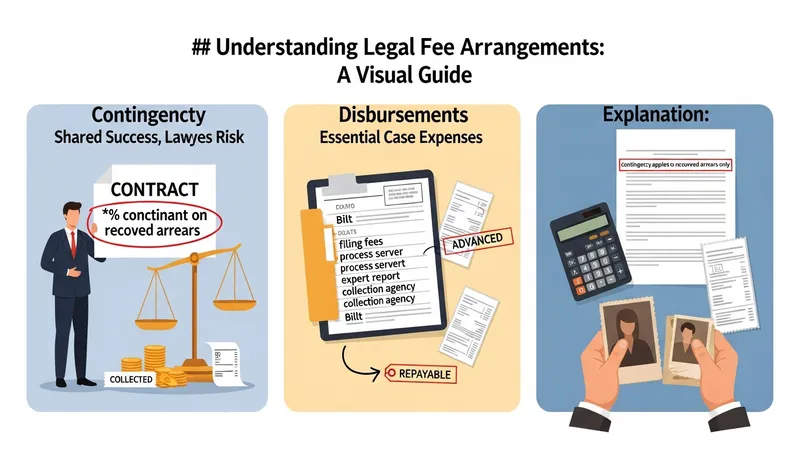
Practically, disbursements present a recurring issue. Filing fees, process server costs, expert reports, and collection agency charges can be significant and are often excluded from contingency calculations. Agreements may state that these amounts are advanced by the lawyer and recovered from a client’s portion of any award, or that the client must reimburse them irrespective of case outcome. Where a lawyer advances costs, the contract should explain whether the advance is repayable on success, on termination, or from the client’s share of proceeds.
Timeframes and milestone payments are another element to consider. A conditional fee might become due upon entry of a final order, on enforcement action that produces payment, or after a negotiated settlement. Some firms use staged triggers so that partial successes lead to proportionate fees; others require full resolution before any payment. Clients should expect the agreement to identify milestones clearly and to explain how partial recoveries are apportioned between lawyer fees and client receipts.
Regulatory and ethical considerations can affect structure availability. In some jurisdictions professional conduct rules restrict contingency arrangements in family law, or require that agreements be assessed for fairness before enforcement. Where regulator oversight exists, it can influence typical percentage ranges or require accounting for client funds and clear disclosure of the lawyer’s role in advancing costs. Understanding these structural variables may assist clients in comparing available arrangements without assuming universal applicability.
Not all child support matters are equally likely to lead to an outcome-dependent fee offer. Cases involving recoverable arrears from a clearly identified obligor, or where there is documentation of unpaid support and a viable enforcement path, are more commonly considered for such arrangements. Paternity establishment actions that create a legal basis for support may also be included if there is reason to expect enforceable obligations. Conversely, highly contested custody disputes or cases with substantial jurisdictional uncertainty can increase litigation costs and reduce the likelihood that a lawyer will accept a conditional-fee arrangement.
Lawyers often evaluate enforcement mechanisms as part of eligibility: availability of wage garnishment, attachment of bank accounts, or support enforcement programs can affect the anticipated likelihood of collection. If enforcement options appear limited—because the obligor lacks wages or assets, or resides in a jurisdiction without reciprocal enforcement agreements—the lawyer may decline an outcome-dependent option or propose a hybrid model. These assessments are typically made early, sometimes at intake, and can shape client expectations about cost exposure and prospects for recovery.
Case complexity matters for both fee calculation and client expectations. Matters requiring multiple expert reports, forensic accounting, or international service of process may increase costs and thus influence fee terms. Attorneys may specify exclusions for high-cost phases or limit the contingency portion to discrete tasks such as collection rather than to the entire litigation. Clients should expect clear explanation of which phases are covered and which are considered extra-contractual for billing purposes.
Alternative funding sources can affect eligibility decisions. Legal aid, pro bono clinics, or community legal services may handle certain child support enforcement matters without outcome-linked fees, and private lawyers may factor the availability of such alternatives into whether to offer conditional terms. Where aid is available, it commonly has eligibility rules; where it is not, private arrangements may be more prominent. Understanding the local funding landscape is often part of determining whether a conditional-fee approach is practical for a particular case.
Clients entering outcome-dependent agreements should understand potential risks and contractual limits. One common risk is that fee liability may arise even if the client does not obtain full relief; for example, an agreement might require payment if a court issues an order but the obligor later defaults. Another risk relates to disbursements: clients can remain responsible for third-party costs even if the success trigger is not met. Contracts may also define partial successes differently, which can lead to disputes over proportional payments. Careful contract language about these scenarios helps to reduce uncertainty.

Ethical and procedural limits can shape what lawyers include in conditional arrangements. In some jurisdictions professional rules restrict contingency fees in family matters or require particular disclosures to the client. Courts may have powers to scrutinize fee agreements when disputes arise or when fees are collected from litigation proceeds. Additionally, lawyers typically retain the right to withdraw from representation for non-cooperation or nonpayment of agreed interim charges, subject to procedural safeguards.
Client responsibilities commonly include timely cooperation, provision of accurate financial information, and participation in enforcement steps. Gathering payroll records, bank statements, and communication logs can materially affect the lawyer’s ability to establish arrears and enforce orders. Clients who delay or withhold information may reduce the chances of successful enforcement or complicate recovery, which can in turn affect how and when any contingent fee becomes payable under the contract.
Practical dispute scenarios should be anticipated. Disagreements can arise over whether an outcome qualifies as a trigger event, how fees are calculated from partial recoveries, or whether advances of disbursements were handled correctly. Many agreements include dispute-resolution mechanisms such as independent review, accounting procedures, or referral to a professional body. Understanding these provisions beforehand may reduce friction if challenging situations occur during the case.
Consumer protection measures often focus on transparency and informed consent. A robust agreement will define success precisely, provide worked examples showing how fees would be calculated in different scenarios, and state whether fees come from gross or net recovered amounts. Where applicable, independent legal advice or a period for review may be recommended or required. Some professional regulators recommend that clients receive detailed billing projections and regular accounting updates so that they can monitor the accumulation of costs and assess whether to continue with litigation.

Court or regulator oversight can act as a safety valve. In some systems courts may review contingent fees taken from litigation proceeds and reduce fees that appear disproportionate to the services provided. Professional conduct rules may require lawyers to avoid arrangements that create conflicts of interest, such as incentives that might discourage reasonable settlement. Awareness of these protections can inform client expectations about what remedies may be available if a fee agreement proves problematic.
Record-keeping and documentation are practical steps clients can take. Retaining copies of fee agreements, invoices, proof of payments, and correspondence about settlement offers helps preserve evidence should disagreements arise. Clients may also request regular written accounts of disbursements and collections to track how any recovered funds are allocated. Such records often make it easier to engage a regulator or an independent reviewer if a fee dispute emerges.
Finally, alternatives and contingency planning matter. Where conditional arrangements are not appropriate or available, limited-scope retainers, flat-fee services for discrete tasks, or referrals to legal aid may be options to consider. Comparing the practical implications of each approach—cost exposure, timeline, and likely enforcement mechanisms—can help a client decide which funding model aligns with their circumstances. The final considerations include checking local professional rules and seeking clarity on contract terms before proceeding.